

Data displayed is pulled from reports from ANCESTRY.COM AND 23 AND ME.com
| JOHN | |
| SCOTTISH | 31 |
| GERMANIC | 21 |
| POLISH | 20 |
| IRISH | 16 |
| SWEDISH | 7 |
| NORWEGIAN | 3 |
| BALTIC | 2 |
| 100 |
| WHAT IT MEANS FOR JOHN | |
| Scottish/Irish | 47 |
| German/Polish | 41 |
| Northern European/Baltic | 12 |
| 100 |

| REINA | |
| PUREPECHA | 44 |
| SPANISH | 14 |
| FRENCH | 14 |
| PORTUGUESE | 8 |
| ASHKENAZIM JEWISH | 2 |
| IRISH | 2 |
| SWEDISH | 2 |
| BANTU | 2 |
| SENEGAMBIAN | 2 |
| INDIGENOUS COLOMBIAN/VENEZUELAN | 2 |
| BASQUE | 1 |
| TURKISH/ARMENIAN | 1 |
| INDIGENOUS CENTRAL AMERICAN | 1 |
| NORTHERN AFRICAN | 1 |
| MAYAN | 1 |
| MALI | 1 |
| SARDINIAN | 1 |
| IRANIAN | 1 |
| 100 |
| WHAT IT MEANS FOR REINA | |
| Central American | 48 |
| Southern European | 37 |
| Middle Eastern/North African/Other | 9 |
| Irish/Northern European/Baltic | 6 |
| 100 |
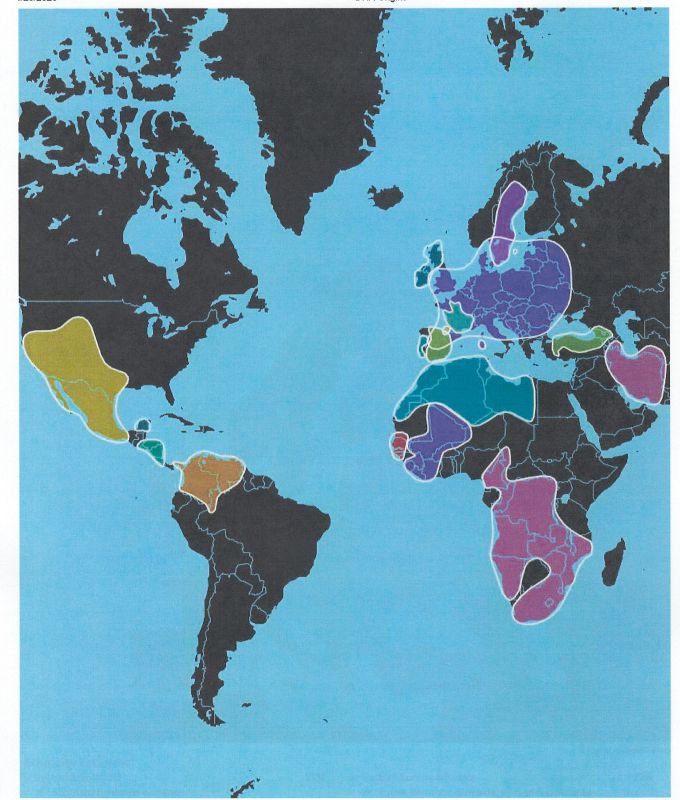
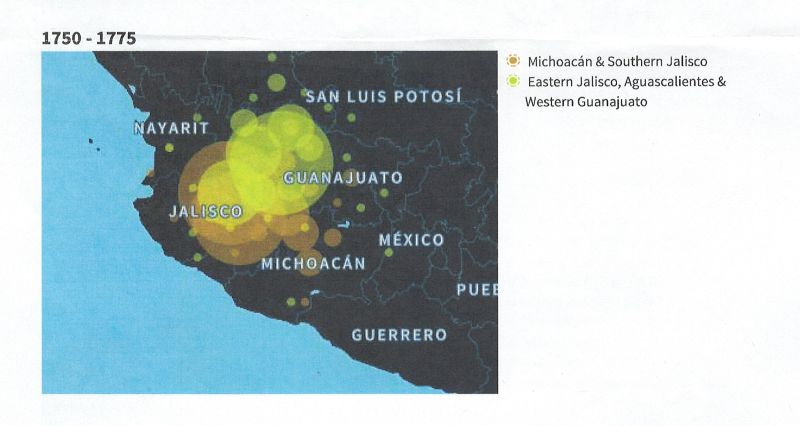
| ELIZABETH/CHRIS | |
| PUREPECHA | 22 |
| SCOTTISH | 15.5 |
| GERMANIC | 10.5 |
| POLISH | 10 |
| IRISH | 9 |
| SPANISH | 7 |
| FRENCH | 7 |
| SWEDISH | 4.5 |
| PORTUGUESE | 4 |
| NORWEGIAN | 1.5 |
| BALTIC | 1 |
| ASHKENAZIM JEWISH | 1 |
| BANTU | 1 |
| SENEGAMBIAN | 1 |
| INDIGENOUS COLOMBIAN/VENEZUELAN | 1 |
| BASQUE | 0.5 |
| TURKISH/ARMENIAN | 0.5 |
| INDIGENOUS CENTRAL AMERICAN | 0.5 |
| NORTHERN AFRICAN | 0.5 |
| MAYAN | 0.5 |
| MALI | 0.5 |
| SARDINIAN | 0.5 |
| IRANIAN | 0.5 |
| 100 |
| WHAT IT MEANS FOR ELIZABETH/CHRIS | |
| Scottish/Irish | 24.5 |
| Central American | 24 |
| German Polish | 20.5 |
| Southern European | 19.5 |
| Northern European/Baltic | 7 |
| Middle Eastern/North African/Other | 4.5 |
| 100 |
John Schmitz maternal Haplogroup is V.

180,000 Years Ago Haplogroup L
If every person living today could trace his or her maternal line back over thousands of generations, all of our lines would meet at a single woman who lived in eastern Africa between 150,000 and 200,000 years ago. Though she was one of perhaps thousands of women alive at the time, only the diverse branches of her haplogroup have survived to today. The story of your maternal line begins with her.
65,000 Years Ago Haplogroup L3
Your branch of L is haplogroup L3, which arose from a woman who likely lived in eastern Africa between 60,000 and 70,000 years ago. While many of her descendants remained in Africa, one small group ventured east across the Red Sea, likely across the narrow Bab-el-Mandeb into the tip of the Arabian Peninsula.
59,000 Years Ago Haplogroup N
Your story continues with haplogroup N, one of two branches that arose from L3 in southwestern Asia. Researchers have long debated whether they arrived there via the Sinai Peninsula, or made the hop across the Red Sea at the Bab-el-Mandeb. Though their exact routes are disputed, there is no doubt that the women of haplogroup N migrated across all of Eurasia, giving rise to new branches from Portugal to Polynesia.
57,000 Years Ago Haplogroup R
One of those branches is haplogroup R, which traces back to a woman who lived soon after the migration out of Africa. She likely lived in southwest Asia, perhaps in the Arabian peninsula, and her descendants lived and migrated alongside members of haplogroup N. Along the way, R gave rise to a number of branches that are major haplogroups in their own right.
10,000 Years Ago Haplogroup V
Recent evidence suggests that the members of haplogroup V descend from a woman who lived in Europe approximately 10,000 years ago. When her ancestors arrived in Europe is more of a mystery. They may have migrated to the west from the Middle East before the last great peak of the Ice Age, which occurred around 20,000 years ago. This wave of cold covered the continental interior in icy tundra and pushed Europe’s human population south into a few temperate enclaves in the south along the Mediterranean. Haplogroup V likely arose in one of these refuges in the Iberian Peninsula, or perhaps in southeastern Europe.
The geographic range of haplogroup V began expanding once consistently warmer conditions arrived about 11,500 years ago. One migration carried it northward along the Atlantic to a low-lying coastal plain rich in game and marine food sources such as seals and sea birds. Known as Doggerland, that region lies under the North Sea today – because so much water was locked up in the polar ice sheets during and immediately after the Ice Age, sea level was lower in the past than it is today.
Doggerland slipped beneath the waves about 9,000 years ago, but haplogroup V remains at levels of about 5% in countries that border the Atlantic and especially the North Sea. It is most abundant today in Scotland and northern Germany. A separate post-Ice Age migration carried haplogroup V through central Europe to western Russia and the Scandinavian Arctic.
10,000 Years Ago Haplogroup V
Your maternal haplogroup, V, traces back to a woman who lived approximately 10,000 years ago. That’s nearly 400 generations ago! What happened between then and now? As researchers and citizen scientists discover more about your haplogroup, new details may be added to the story of your maternal line.
Today Haplogroup V
V is frequent among the general population. Today, you share your haplogroup with all the maternal-line descendants of the common ancestor of V.
John paternal Haplogroup is R-S5556

275,000 Years Ago Haplogroup A
The stories of all of our paternal lines can be traced back over 275,000 years to just one man: the common ancestor of haplogroup A. Current evidence suggests he was one of thousands of men who lived in eastern Africa at the time. However, while his male-line descendants passed down their Y chromosomes generation after generation, the lineages from the other men died out. Over time his lineage alone gave rise to all other haplogroups that exist today.
76,000 Years Ago Haplogroup F-M89
For more than 100,000 years, your paternal-line ancestors gradually moved north, following available prey and resources as a shifting climate made new routes hospitable and sealed off others. Then, around 60,000 years ago, a small group ventured across the Red Sea and deeper into southwest Asia. Your ancestors were among these men, and the next step in their story is marked by the rise of haplogroup F-M89 in the Arabian Peninsula.
53,000 Years Ago Haplogroup K-M9
Passing through the Middle East, your paternal-line ancestors continued on to the steppes of Central Asia, vast grasslands stretching all the way from central Europe to the eastern edge of Asia. From its origin in the western steppes nearly 50,000 years ago, haplogroup K-M9 spread across most of the globe. In fact, nearly half of all paternal lineages outside of Africa are branches of haplogroup K.
35,000 Years Ago Haplogroup R-M207
The next step in your story can be to the common ancestor of haplogroup R, a man who likely lived in Central Asia between 30,000 and 35,000 years ago. The Ice Age was still in full swing, and for thousands of years his descendants roamed the vast steppes of the continent, where they hunted huge mammals like the mammoth.
27,000 Years Ago Haplogroup R-M343
Your ancestral path forked off again between 20,000 and 25,000 years ago in western Asia, at the beginning of the last great peak of the Ice Age. Massive glaciers covered northern Eurasia, but farther south in the Iranian Plateau your ancestors flourished. When the Ice Age finally gave way to our warmer climate nearly 11,500 years ago, a new era of migrations from the Middle East began and eventually carried haplogroup R-M343 across three continents.
10,000 Years Ago Haplogroup R-M269
Your paternal line stems from a branch of R-M343 called R-M269, one of the most prolific paternal lineages across western Eurasia. R-M269 arose roughly 10,000 years ago, as the people of the Fertile Crescent domesticated plants and animals for the first time. Around 8,000 years ago, the first farmers and herders began to push east into Central Asia and north into the Caucasus Mountains. Some of them eventually reached the steppes above the Black and Caspian Seas. There, they lived as pastoral nomads, herding cattle and sheep across the grasslands, while their neighbors to the south developed yet another crucial technology in human history: bronze smelting. As bronze tools and weaponry spread north, a new steppe culture called the Yamnaya was born.
Around 5,000 years ago, perhaps triggered by a cold spell that made it difficult to feed their herds, Yamnaya men spilled east across Siberia and down into Central Asia. To the west, they pushed down into the Balkans and to central Europe, where they sought new pastures for their herds and metal deposits to support burgeoning Bronze Age commerce. Over time, their descendants spread from central Europe to the Atlantic coast, establishing new trade routes and an unprecedented level of cultural contact and exchange in western Europe.
The men from the steppes also outcompeted the local men as they went; their success is demonstrated in the overwhelming dominance of the R-M269 lineage in Europe. Over 80% of men in Ireland and Wales carry the haplogroup, as do over 60% of men along the Atlantic Coast from Spain to France. The frequency of R-M269 gradually decreases to the east, falling to about 30% in Germany, 20% in Poland, and 10-15% in Greece and Turkey. The haplogroup connects all these men to still others in the Iranian Plateau and Central Asia, where between 5 and 10% of men also bear the lineage.
< 10,000 Years Ago Haplogroup R-S5556
Your paternal haplogroup, R-S5556, traces back to a man who lived less than 10,000 years ago. That’s nearly 400 generations ago! What happened between then and now? As researchers and citizen scientists discover more about your haplogroup, new details may be added to the story of your paternal line.
Today Haplogroup R-S5556 R-S5556 is relatively common
John, you have more Neanderthal DNA than 89% of the population, All together, this makes up less than 2% of your DNA.
Reina Aguila Maternal Haplogroup L3f1b4a – See Below as all Maternal Haplogroups are directly passed from mother to children
Elizabeth/Chris Schmitz Maternal Haplogroup L3f1b4a

WHAT IS A MATERNAL HAPLOGROUP?
As our ancestors ventured out of eastern Africa, they branched off in diverse groups that crossed and recrossed the globe over tens of thousands of years. Your maternal haplogroup can reveal the path followed by the women of your maternal line.
180,000 Years Ago Haplogroup L
If every person living today could trace his or her maternal line back over thousands of generations, all of our lines would meet at a single woman who lived in eastern Africa between 150,000 and 200,000 years ago. Though she was one of perhaps thousands of women alive at the time, only the diverse branches of her haplogroup have survived to today. The story of your maternal line begins with her.
65,000 Years Ago Haplogroup L3
Your branch of L is haplogroup L3, which arose from a woman who likely lived in eastern Africa between 60,000 and 70,000 years ago. While many of her descendants remained in Africa, one small group ventured east across the Red Sea, likely across the narrow Bab-el-Mandeb into the tip of the Arabian Peninsula.
46,000 Years Ago Haplogroup L3f
Your maternal line stems from a branch of L3 called L3f. Haplogroup L3f is an old offshoot that traces back to a woman who likely lived nearly 46,000 years ago. Members of L3f live in a wide distribution across the Sahel belt of Africa, a dry savanna region on the southern fringe of the Sahara Desert, as well as in the northern regions of the Central African rainforest.
Between 20,000 and 30,000 years ago, L3f gave rise to two daughter haplogroups, L3f1 and L3f2. L3f1 appears to have arisen in eastern Africa and moved westward before the peak of the Ice Age about 20,000 years ago, when the Sahara Desert expanded and rendered much of the northern part of the continent uninhabitable. Today the haplogroup is commonly found among the Yoruba and Fulbe populations of western Africa, and in African-Americans who are descended from them. Haplogroup L3f2 originated in the Chad Basin of northern-central Africa, where it has been largely confined since then. It has not been detected in African-American populations, an indication that the Atlantic slave trade did not reach as far inland as present-day Chad and Niger.
5,000 Years Ago Haplogroup L3f1b4a
Your maternal haplogroup, L3f1b4a, traces back to a woman who lived approximately 5,000 years ago. That’s nearly 200 generations ago! What happened between then and now? As researchers and citizen scientists discover more about your haplogroup, new details may be added to the story of your maternal line.
Today Haplogroup L3f1b4a
L3f1b4a is relatively uncommon . Today, you share your haplogroup with all the maternal-line descendants of the common ancestor of L3f1b4a.
Members of L3 were swept along in the Bantu Migrations.
About 5,000 years ago, many people in sub-Saharan Africa still relied on hunting, gathering, and foraging as their main means of collecting food. But that was soon going to change. People in West-Central Africa began experimenting with agriculture, cultivating the yams, legumes, peppers, and gourds that would became staples of sub-Saharan African diet. These people spoke languages belonging to the Bantu language family, and about 4,000 years ago they began to move.
First, they headed east across the central rainforest. Eventually, the descendants of these migrants arrived at the farthest reaches of southern Africa. Later, other Bantu speakers who had remained in West Africa also began to travel down the western coast. As they traveled over a period of centuries, they both displaced and absorbed many other hunter-gatherer groups that were already living throughout Africa.Their agricultural and technological knowledge also diffused to other local groups. They often intermarried, sometimes adopting local cultural practices of those people they encountered. The languages that they brought with them from their ancestral homeland spread throughout sub-Saharan Africa, and today the majority of sub-Saharan African languages are Bantu.
you have 283 Neanderthal variants.
You have more Neanderthal variants than 63% of the population. However, your Neanderthal ancestry accounts for less than 4% of your overall DNA.
APPENDIX: ANCESTRY POPULATIONS
African Hunter-Gatherer: African hunter-gatherer populations — including the Pygmy and San peoples of central and southern Africa — represent some of the oldest and most genetically distinct branches in the human family tree. The historically semi-nomadic San peoples of the Kalahari and the closely-related Khoe herders in Namibia, Botswana, and South Africa, speak languages characterized by click consonants rarely found in other language families. Pygmy peoples of the central African rainforests, on the other hand, have lost their distinct linguistic heritage, but have preserved many unique cultural traditions.
Angolan & Congolese: Beginning around 3,000 years ago, the genetic tapestry of the western Congo basin was transformed by the influx of Bantu-speaking peoples from the highlands of what is today Nigeria and Cameroon. More recently, Bantu speakers in the western Congo region established the historical Kingdom of Kongo, which flourished for over 500 years until its collapse at the hands of colonial powers in 1914. Today, Bantu-speaking peoples (such as the Kongo, Teke, Mbochi, and Sangha) are significant majorities in the countries bordering the Congo River.
Ashkenazi Jewish: Ashkenazi Jewish people settled in Central and Eastern Europe in the late Middle Ages, but their modern descendants remain genetically more similar to other Jewish populations than to their European neighbors, reflecting shared western Asian origins. In the twentieth century, many Ashkenazi Jewish people immigrated to Israel or to the Americas in search of greater cultural and religious acceptance. Today, over five million ethnic Ashkenazi Jewish people live in the U.S.
British & Irish: The British Isles have been continuously occupied by humans for the last 11,000 years, but more recently, the people of the Isles have left their genetic fingerprints around the world, following centuries of nautical exploration, colonization, and immigration. In the early 20th century, the Republic of Ireland won its independence from the United Kingdom, but the people of these nations share a common genetic heritage rooted largely in Celtic, Anglo-Saxon, and Viking migrations from northwestern Europe.
Broadly Chinese & Southeast Asian: From the expansive plains of central Asia to the islands of eastern Indonesia, the people of China and Southeast Asia share genetic similarities dating back to the arrival of humans in the region over 40,000 years ago. Broadly Chinese & Southeast Asian DNA – likely driven in part by the spread of agriculture within the last few thousand years – matches several specific populations and is difficult to assign to just one.
Broadly Congolese & Southern East African: Starting around 3,000 years ago, Bantu speakers carried metallurgy and agriculture from the highlands of Nigeria and Cameroon in two major streams – one southward and one eastward – resulting in ancestry that transcends geopolitical borders. “Bantu” is a term widely used to describe the largest of Africa’s ethnolinguistic families. Likely as a result of these rapid and widespread expansions across Central and Eastern Africa, it is difficult to assign a specific location within Sub-Saharan Africa to some chromosomal segments with a high degree of confidence.
Broadly East Asian & Native American: The peoples of East Asia and the Americas have a shared genetic history. Their common ancestors left western Asia over 50,000 years ago, migrating east across the continent. The ancestors of Native Americans began to cross into the Americas 12,000 to 15,000 years ago. Broadly East Asian & Native American DNA is a relic of this ancient population split, and reflects shared roots in central and northern Asia.
Broadly European: Much of Europe was buried under miles of ice ten thousand years ago. As the glaciers receded over millennia, Neolithic farmers from western Asia joined Paleolithic hunter-gatherers to settle Europe. Some European DNA is difficult to assign confidently to one population and receives a ‘Broadly’ designation.
Broadly Japanese & Korean: The people of Japan and the Korean Peninsula share a genetic heritage that dates back to the first arrival of Stone Age hunter-gatherers from Siberia, and to later migrations of Iron Age rice farmers from the south. Broadly Japanese & Korean DNA is a remnant of this ancient population history and is difficult to assign to Korean or Japanese ancestry alone. More recently, the region has been shaped by a rich history of artistic, literary, architectural, and scientific exchange.
Broadly Melanesian: Melanesia was first peopled by seafaring voyagers over 45,000 years ago, when the ancestors of indigenous Australian and Papuan peoples reached Near Oceania from Indonesia. These early Melanesians interbred with a now-extinct hominin species – the Denisovans – and their descendants harbor traces of this ancient encounter in their DNA.
Broadly Northern Asian & Native American: Dispersed across three continents, the peoples of Northern Asia and the Americas have deeply-rooted genetic similarities, reflecting a history of widespread and rapid migrations across the vast central Asian plains, Siberia, and eventually into the Americas across the Bering land bridge. Subtle linguistic affinities reveal ancient links between some Native American languages and languages still spoken in Siberia. Broadly Northern Asian & Native American DNA is a relic of this ancient population split, and is difficult to assign to a specific region.
Broadly Northern East African: Northeast Africa, which here spans from Sudan in the northwest to Ethiopia and Somalia in the southeast, is home to both Afro-Asiatic and Nilo-Saharan ethnolinguistic groups. The entire region has a rich history of genetic and cultural exchange between indigenous East Africans and immigrants from the Arabian Peninsula. As a result of both ancient and recent migrations within the region, broadly Northeast African DNA may be difficult to assign to a specific location.
Broadly Northwestern European: Northwestern European ancestry is represented by people from as far west as Ireland, as far north as Norway, as far east as Finland, and as far south as France. These countries rim the North and Baltic Seas, and have been connected throughout much of history by those waters. Broadly Northwestern European DNA matches several specific populations and is difficult to assign to just one. This shared heritage may be a result of extensive migration, possibly including the Germanic invasions of the early Middle Ages.
Broadly South Asian: South Asia is represented here by the diverse populations of India, Sri Lanka, Pakistan, Afghanistan, Nepal, Bhutan, and Bangladesh. Scientists believe that when modern humans first left Africa, they traveled along the coast of southern Asia, populating parts of the region over 50,000 years ago. During the last few thousand years, the genetic and cultural landscape of South Asia has shifted following migrations from the North and West.
Broadly Southern European: Southern Europe, which includes the Iberian, Italian, and Balkan peninsulas as well as the island of Malta, is a region defined in great part by the Mediterranean Sea. The Mediterranean has provided transportation routes, keeping these regions connected culturally and genetically. Broadly Southern European DNA matches several specific populations and is difficult to assign to just one.
Broadly Sub-Saharan African: The genetic diversity of Sub-Saharan Africa reflects both the deep history of humans in the region and the recent migrations that have carried people from western Africa to both southern and eastern Africa. As a result of this ancient and complex population history, it is difficult to assign some DNA to a specific population within Sub-Saharan Africa.
Broadly West African: For over a millennium before European colonization and the Atlantic slave trade, West Africans were united under a series of powerful empires, resulting in broad similarities in music, clothing, art, and cuisine. A gradient of genetic similarity extending from Senegal to Nigeria reflects a richly complex population history in a region home to over 350 million people who form hundreds of distinct ethnic groups.
Broadly West African DNA may match several populations, making it difficult to assign to just one.
Broadly Western Asian & North African: The peoples of western Asia and North Africa have not only genetic but also deep linguistic connections with one another. Broadly Western Asian & North African DNA reflects shared roots possibly dating back to some of the earliest migrations out of Africa. The spread of Islam in the past 1,400 years has also dramatically shaped the region’s genetic landscape, making it difficult to assign some DNA to just one population.
Chinese: China is home to one of the world’s earliest and most enduring civilizations, with over 50 officially-recognized ethnic groups. The Han ethnic group makes up 92% of the country’s population, and includes nearly one-fifth of all humans in the world. Over 50 million ethnic Chinese live outside of China, with over 20 million in Thailand, Malaysia, and the United States alone.
Chinese Dai: The Dai people of southern China belong to the larger Tai ethnolinguistic group that currently lives in parts of China, Burma, Laos, Vietnam, and Thailand. In China, the Dai are one of over 50 officially recognized ethnic minority groups, and are united by unique cultural traditions anchored in Dai Folk Religion or Buddhism. Most Chinese Dai live in southern and western Yunnan Province, and are genetically more similar to their Vietnamese neighbors than they are to the Han Chinese.
Eastern European: Between the eighteenth and twentieth centuries, Eastern Europe was heavily influenced by Imperial (and then Soviet) Russia, but the genetic heritage of Eastern Europe traces back to peoples living southeast of the Baltic Sea as well as to a more recent influx of Slavic-speaking peoples from north of the Black Sea. After the collapse of the Soviet Union in 1991, millions of Eastern Europeans migrated west in search of economic opportunity. In the United States, Eastern European ancestry is most common in the Midwest.
Ethiopian & Eritrean: Despite recent conflict, Eritreans and Ethiopians were united under the powerful Kingdom of Aksum for almost 1,000 years until its collapse in 940 CE, and their DNA reflects that shared history. The region has also served as a crossroads between Africa and the Arabian Peninsula for tens of thousands of years. Today, most Ethiopians and Eritreans have both East African and Arabian ancestry and speak Afro-Asiatic languages, including Oromo, Tigrinya, Arabic, and Amharic.
Filipino & Austronesian: Many indigenous Filipinos, including the Aeta, Batak, and Mamanwa peoples, are likely descended from one of the earliest dispersals of modern humans out of Africa. However, most Filipinos can trace their ancestry to a much more recent and widespread migration of Southeast Asian seafarers related to the indigenous people of Taiwan. Today, this genetic signature – called “Austronesian” (meaning “southern island”) – is common across the islands of the Pacific, from the Philippine Sea to Hawaii, and can be found as far away as Madagascar.
Finnish: Finland was peopled by multiple waves of colonization, including a migration of early Uralic peoples from Eastern Europe or western Siberia. Modern Finns are genetically and linguistically distinct from their Nordic and Slavic neighbors, despite centuries of Swedish and then Russian rule. Today, there are up to seven million ethnic Finns worldwide, with over 600,000 living in the United States, concentrated in Minnesota and northwestern Michigan.
French & German: “French and German” people descend from ancient Alpine-Celtic and Germanic populations, and inhabit an area extending from the Netherlands to Austria – roughly corresponding to the extent of Charlemagne’s Frankish Kingdom in the Middle Ages. Estimates place Charlemagne himself in the family trees of all modern Europeans, possibly many times over. Genetically and geographically, this population’s people are at the heart of Europe.
Ghanaian, Liberian & Sierra Leonean: A continuum of genetic diversity stretches from Senegal to Nigeria, but the people of the coastal countries above the Gulf of Guinea — Sierra Leone, Liberia, Côte d’Ivoire, and Ghana — share a genetic similarity distinct from neighboring regions. The Temne people, who constitute the largest group in Sierra Leone, call this region home, as do the Mende people, who reside across West Africa. In neighboring Côte d’Ivoire and Ghana, the Akan peoples predominate.
Greek & Balkan: The Balkan Peninsula is nestled in the southeastern corner of Europe and serves as the geographic and genetic crossroads between Europe and western Asia. Despite broad cultural and religious diversity, Greek and Balkan people are genetically similar to one another, descending from early Mediterranean and Slavic peoples. Island Greeks lack this ancestral Slavic influence and are similar to southern Italians.
Indonesian, Thai, Khmer & Myanma: From Myanmar to Indonesia, the people of Southeast Asia are genetically diverse, reflecting the legacies of several migrations beginning over 40,000 years ago. More recently, the region has been heavily influenced by Hindu, Buddhist, and Islamic cultures. Before its fall in the fifteenth century, the Khmer empire – encompassing modern-day Thailand, Laos, and Cambodia – was the largest land empire in the region’s history.
Italian: The famously boot-shaped Italian peninsula has been home to modern humans for over 30,000 years. In the early Middle Ages, Germanic invaders brought about the fall of the Western Roman Empire, and a northern European genetic signature persists in modern Italians to this day. This influence is strongest in the north, while southern Italians share a rich genetic heritage with island Greeks. Over the millennia, a number of migrations from around the Mediterranean brought North African and Western Asian ancestry to Italy as well.
Japanese: The Japanese Archipelago, composed of a whopping 6,852 islands, was colonized by multiple waves of immigrants beginning as early as 30,000 BCE. Modern Japanese people can trace most of their ancestry to the Stone Age Jōmon and late Stone Age Yayoi cultures. Yayoi DNA is concentrated in the center of Japan, while Jōmon ancestry persists to the north and south among the culturally distinctive Ainu and Ryukyuan peoples.
Korean: The Korean peninsula was first inhabited by hunter-gatherers who were genetically similar to Stone Age peoples living near the Amur River in eastern Russia. These early Koreans were later joined by Bronze-Age rice farmers from southern China or Vietnam. By the tenth century, Korea was politically and culturally unified and remained so until the establishment of a communist north and a democratic south after the Second World War. Although North and South Koreans are politically divided, they remain genetically similar to one another.
Manchurian & Mongolian: The Manchurian and Mongolian population includes ethnolinguistic minorities like the Daur — who speak a language related to Mongolian — and the Oroqen, who speak a Tungusic language and live near the Amur River basin. These groups reside at the juncture of the Central Asian plains, boreal forests, and the Gobi Desert. Linguistically distinct but genetically similar, Mongolian and Manchurian peoples generally practice shamanism and Tibetan Buddhism.
Native American: The first humans to reach the New World populated much of North, Central, and South America within just a few thousand years following their arrival from northeast Asia around 15,000 years ago. Despite drastic population losses over the past 500 years as a result of exposure to Old World diseases and genocide at the hands of European colonizers, the genetic legacy of these early American trailblazers persists to this day, primarily in Central and South America.
Nigerian: Nigeria’s population is the largest in Africa and one of the most diverse, with over 250 ethnic groups. The country’s arid north is home to people of mostly Hausa and Fulani descent, while the Yoruba are concentrated in the southwest, the Ijaw in the tropical south, and the Igbo in the southeast. As much as two thirds of African-Americans’ Sub-Saharan DNA may trace back to Nigerian ancestors, due to the disproportionate impact of the Atlantic slave trade on the people of the region.
North African & Arabian: Although early humans lived north of the Sahara as early as 300,000 years ago, the recent ancestors of North Africans were more closely related to some non-African populations. This relationship reflects an intricate history of migrations into present-day Morocco, Algeria, Tunisia, Libya, and Egypt from the Arabian Peninsula. An older North African genetic legacy peaks in Berbers of the Maghreb and in the indigenous people of the Canary Islands.
Sardinian: Sardinians are outliers in the genetic landscape of Europe, thanks to the geographic isolation of their rugged island home off of mainland Italy. Over the centuries, Sardinians resisted assimilation by occupying forces and have managed to preserve a few unique traditions, including “Cantu a Tenòre,” a haunting style of overtone singing practiced to this day.
Scandinavian: Scandinavians – represented by the people of Norway, Sweden, Denmark, and Iceland – owe much of their linguistic and genetic heritage to North Germanic tribes who established settlements around the North Sea during the late Middle Ages. Many Scandinavians, like the Sámi people in the far north, are descendants of early Scandinavian hunter-gatherers. In the United States, Scandinavian ancestry is most common in North Dakota.
Senegambian & Guinean: The people of Senegal, The Gambia, Guinea, and Guinea-Bissau share many traditions related to the history of powerful empires in the region. In The Gambia, the Mandinka people are the largest group, with historical roots along the Niger River basin, while the Wolof people form the majority in neighboring Senegal. In Guinea and Guinea-Bissau the Fulani people predominate, and may have subtle genetic links to North Africa or western Asia. In the 18th century, around 400,000 people from this region were enslaved and transported to the Americas; nearly 50,000 disembarked in the United States alone.
Siberian: Many ethnolinguistic groups call the northern reaches of Asia home. Among them are the Yukaghir, the Nganasan, and the Turkic-speaking Yakuts, who migrated North and East from southern Siberia between 700-900 years ago to escape encroaching raiders. Today, the Yakuts are a large ethnic minority in northeastern Siberia and share genetic similarities with other indigenous groups in the region including the Evenks, Evens, and Buryats. Indigenous Siberians are often well adapted to climate extremes, as they face some of the largest annual temperature fluctuations in the world.
Somali: While modern humans have lived in East Africa for over 200,000 years, ethnic Somalis living in Somalia, Eastern Ethiopia and Kenya trace much of their genetic heritage and social structure to 9th century migrations from the Arabian Peninsula. Almost all ethnic Somalis belong to one of five major patrilineal clans and this clan structure is integral to the cultural and political fabric of Somali society. Many Somalis immigrated to North America, Europe, or Western Asia in response to civil war in the twilight of the 20th century.
Southern East African: Within the last 3,000 years, metallurgy and agriculture arrived in Southern East Africa with the migration of Bantu-speaking peoples from the highlands of what is today Nigeria and Cameroon. The historical center of this Eastern Bantu migration lies in the African Great Lakes region that runs along the Western edge of Kenya and Tanzania. Today, the largest ethnic groups in Burundi, Kenya, Rwanda, Tanzania, and Uganda all speak Bantu languages.
Spanish & Portuguese: The genetic landscape of the Iberian Peninsula – represented today by the people of Spain and Portugal – was influenced by several Mediterranean civilizations, including 800 years of Arabic North African rule. Now, a small North African genetic signature is present in Spanish & Portuguese DNA, and over eight percent of Spanish words carry Arabic origins. Conquistadors from Portugal and Spain colonized parts of Africa, Oceania, and the Americas, and this ancestry is now relatively common in Latino peoples from Central and South America.
Sudanese: Sudan and South Sudan share a distinct genetic heritage dating to early agricultural civilizations, including the Nubian Kingdoms of Kush and Meroë that once flourished along the banks of the upper Nile. Today, the people of Sudan and South Sudan are ethnically diverse, following a long history of intermarriage between indigenous East Africans and migrants from the Arabian peninsula. However, this Arabian genetic legacy is less common in the south of the region.
Unassigned: There is a wide range of human diversity out there, and sometimes our algorithm can’t pinpoint a region of your DNA to a specific population. Bear with us as our data and resources continue to expand. We expect the amount of unassigned ancestry our customers see to decrease.
Vietnamese: Present-day Vietnam was the cradle of one of the world’s earliest civilizations, and one of the world’s first regions to develop rice-based agriculture. A tropical country on the Indochinese Peninsula, Vietnam is bordered by China to the north and by Laos and Cambodia to the west. The country has 54 ethnic groups, the largest being the Kinh, who make up more than 85% of the population.
Western Asian: Domestication of grains and livestock emerged 11,000 years ago in western Asia, sparking the agricultural revolution that eventually spread to Europe, Africa, and the rest of Asia. From the Caucasus to Iran, western Asia is an important crossroads in the human migration out of Africa, and the genetics of this region reflect that role. A western Asian genetic signature also appears in North Africa and southern Europe.